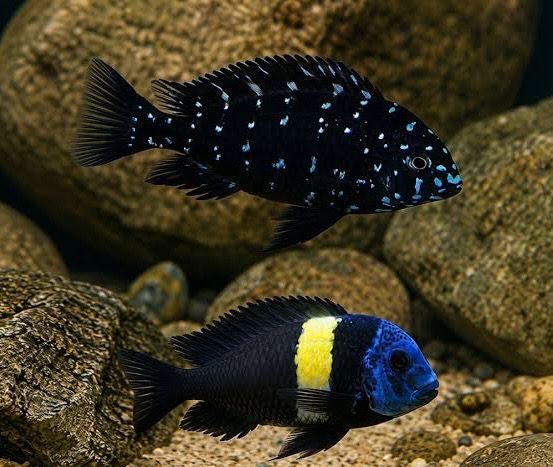
Tropheus Duboisi
Share
R150.00
Buy and save
Buy and earn R0.30 Loyalty for your next purchase
Loyalty is a discount program that lets you buy products and earn points to redeem on your next purchase. Your Loyalty balance is updated when you pay online or in-store. The Loyalty amount shown on this page can be recalculated at the checkout.
In stock
Tropheus Duboisi
Share
Product details
⭐ Tropheus Duboisi
Tropheus duboisi
White Spotted Tropheus | Lake Tanganyika Cichlid
“Born in polka dots. Transformed into an icon.”
💎 Product Overview
The Tropheus Duboisi is one of Lake Tanganyika’s most extraordinary cichlids, famous for undergoing a remarkable transformation as it matures.
Juveniles are instantly recognisable, displaying a deep black body scattered with brilliant white to pale-blue spots, creating an almost starry appearance.
As they mature, this juvenile pattern gradually disappears and gives way to the sophisticated adult coloration for which the species is equally famous: a dark body, blue-toned head and bold vertical band across the centre of the fish.
It is almost like owning two completely different fish during its lifetime.
Beyond its appearance, Tropheus duboisi offers the complex social behaviour, constant activity and unmistakable personality that make Tropheus so highly regarded among dedicated African cichlid enthusiasts.
✨ Why We Love Them
- Spectacular black-and-white spotted juveniles
- Dramatic transformation into adult coloration
- Beautiful blue tones developing around the head
- Bold contrasting adult body band
- Active and highly engaging behaviour
- Fascinating Tropheus social hierarchy
- Exceptional in dedicated rocky Tanganyika displays
- Maternal mouthbrooding behaviour
- A true collector's African cichlid
🎨 From Juvenile to Adult
Few aquarium fish undergo a transformation quite as dramatic as the Duboisi.
Juveniles
Young Duboisi display a dark, almost jet-black base covered with numerous contrasting light spots.
Adults
As the fish develops, those juvenile spots gradually disappear. The mature fish develops a dark body with beautiful blue coloration around the head and a prominent yellowish or white vertical band, depending on the geographical variety.
Customers purchasing juveniles should therefore understand that the beautiful spotted pattern is not permanent.
The transformation is part of what makes this species so special.
🌿 Care Requirements
- Scientific Name: Tropheus duboisi
- Common Name: Duboisi Tropheus / White Spotted Tropheus
- Origin: Lake Tanganyika, Africa
- Adult Size: Approximately 12–13 cm
- Care Level: Advanced
- Temperature: Approximately 24–28°C
- pH: Approximately 8.0–9.0
- Water: Hard and alkaline
- Temperament: Territorial / aggressive
- Diet: Primarily herbivorous
- Aquarium Style: Spacious rocky Lake Tanganyika setup
Tropheus thrive in exceptionally stable conditions with excellent filtration, strong oxygenation and consistently high water quality.
👥 Group Behaviour
Tropheus Duboisi should be approached as a social group fish rather than simply another African cichlid.
They develop complex hierarchies and can show considerable aggression toward one another.
For this reason, the aquarium should be carefully planned around the Tropheus group from the beginning, with sufficient space and structure to help distribute aggression.
A properly established group becomes an incredibly active, engaging display.
🪨 The Perfect Duboisi Aquascape
Create a sophisticated Lake Tanganyika-inspired aquarium using:
- Extensive rock formations
- Multiple ledges and crevices
- Broken lines of sight
- Open swimming areas
- Fine sand substrate
- Strong filtration
- Excellent circulation and oxygenation
Rockwork also provides valuable surfaces on which algae and biofilm can develop, encouraging the natural grazing behaviour associated with Tropheus.
🌿 Feeding
Diet is one of the most important considerations when keeping Tropheus.
Duboisi are specialised algae and plant-matter grazers and should receive a predominantly vegetable-based diet.
Suitable foods include:
- Premium Spirulina flakes
- High-quality herbivore cichlid pellets
- Vegetable-rich foods
- Suitable algae-based foods
Avoid overfeeding and excessive quantities of rich, meaty or high-protein foods.
Small, controlled meals are preferable and better reflect their natural grazing strategy.
🐠 Compatible Tank Mates
Our preferred choice is a dedicated Tropheus aquarium.
This allows the aquarist to control diet, social structure and aggression far more effectively.
Experienced African cichlid keepers with sufficiently large aquariums may sometimes keep Duboisi with carefully selected herbivorous Lake Tanganyika cichlids that share similar water and dietary requirements.
Any mixed-species Tropheus aquarium should be planned around:
- Compatible diet
- Similar water requirements
- Adult size
- Territorial behaviour
- Available aquarium space
- Rockwork and territory distribution
For most customers, we recommend keeping Tropheus Duboisi as the feature species.
🚫 Fish We Would Avoid
We do not recommend adding Tropheus Duboisi to a standard mixed Malawi Mbuna aquarium, even when all the fish are currently juveniles.
Young fish may appear perfectly compatible at first, but behaviour and territorial aggression can change substantially as they mature.
Also avoid:
- Peaceful community fish
- Small tetras and rasboras
- Angelfish
- Discus
- Rainbowfish
- Goldfish
- Delicate bottom dwellers
- Fish requiring soft or acidic water
- Species requiring a substantially different diet
The safest premium display is one designed around the Tropheus rather than simply including Tropheus in an existing aquarium.
❤️ Breeding Behaviour
Tropheus duboisi is a maternal mouthbrooder.
Following spawning, the female carries the developing eggs and young inside her mouth, protecting them during their vulnerable early development.
This remarkable behaviour adds another dimension to watching an established Tropheus group.
⚠️ A Specialist African Cichlid
Tropheus Duboisi are not an ideal impulse purchase.
They require thoughtful attention to:
- Group size
- Social hierarchy
- Diet
- Aquarium size
- Water chemistry
- Filtration
- Oxygenation
- Long-term stocking
When those requirements are met, however, they reward the aquarist with one of the most fascinating African cichlid displays available.
💎 The Bubbly Fish Selection
The Tropheus Duboisi doesn't simply mature.
It transforms.
From the star-like white spots of a juvenile to the powerful blue, black and contrasting band of adulthood, Tropheus duboisi offers a visual journey few freshwater fish can replicate.
For the dedicated African cichlid enthusiast, it is a genuine Lake Tanganyika icon.
“Spotted as a juvenile. Striking as an adult. Extraordinary for life.”
Display prices in:ZAR